Yamamoto Lab@BCM

Why Flies?
What's so special about these little bugs?
Do these animals even have a brain?
What kind of experiments can you do,
and what can you learn from them?
Flies are great for biomedical research because...
Small size &
cost efficient
(Under construction)
Short lifecycle &
short lifespan
(Under construction)
Dramatic morphological &
behavioral phenotypes
(Under construction)
Conserved genes &
sophisticated genetics
(Under construction)
6 (or 7?) Nobel Prizes in Physiology & Medicine awarded to flies

To be accurate, it is the scientists who received the awards, not the flies themselves, but there have been a number of Drosophilists who received the Nobel Prize in Physiology & Medicine for their outstanding contributions to biomedical sciences.
Transgenic flies made in house (relatively easily)!

(Under construction)
'Humanizing' a fly is not science fiction!

(Under construction)
Naming a fly gene
The first person to functionally characterize a previously unstudied fly gene gets the privilege to name the gene of interest. Here are some fly genes named by us.

CG3073
This gene encodes an evolutionarily conserved (PTAR1 in human) novel protein prenyltransferase, a type of enzyme that adds lipid moieties to certain proteins. Tempura is a traditional Japanese dish that takes proteins (e.g., shrimp) and adds lipids (deep fried).

CG11103
This gene encodes a previously uncharacterized protein that is evolutionarily conserved (TM2D2 in human). Because its sequence and phenotype are similar to almondex, we decoded to name this gene after an almond-based Italian liqueur.

CG10795
This gene encodes a previously uncharacterized protein that is evolutionarily conserved (TM2D1 in human). Because its sequence and phenotype are similar to almondex, we decided to name this gene after an almond-based Italian biscuit.
Acknowledging the great artist, Edith M. Wallace

Edith M. Wallace worked in the laboratory of Thomas Hunt Morgan in the early 20th century. Her detailed drawings of wild-type and mutant Drosophila not only have extreme scientific value, but are also valuable pieces of art. Many of her original drawings are archived in Caltech (to where Morgan's lab moved from Columbia in 1928), and some can be found online from several digital libraries (JSTOR, DPLA) and databases (Caltech Archives). Her illustrations have also been extensively used in the 'Red Book', which became the foundation of FlyBase. The 'Drawing of Drosophila (1934)', depicting one male and one female wild-type Drosophila melanogaster in full color, shown on the top of this page, is also a masterpiece by Ms. Wallace.
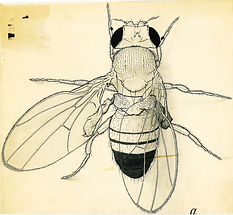
A bithorax mutant fly

A hairless mutant fly
![Cy_S[2]_E(S)_gt.png](https://static.wixstatic.com/media/3a414a_f2217546549445b6ae0e30bcf85726a6~mv2.png/v1/fill/w_250,h_215,al_c,q_85,usm_0.66_1.00_0.01,enc_avif,quality_auto/Cy_S%5B2%5D_E(S)_gt.png)
A fly with multiple mutations including Curly
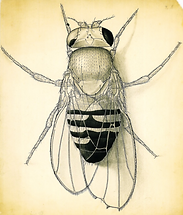
A gynandromorph
(male-female mosaic) fly

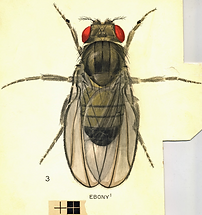
An ebony mutant fly
